
What the Declarant Deadline Means for Businesses Importing into the EU
Emissions Trading System

EU carbon pricing is expanding. Is your business ready?
By: Kiara Conings
30 Oct 2026 4 min read
Carbon pricing is no longer an issue only for power producers and heavy industry.
Aviation, shipping, fuel suppliers and importers are increasingly part of the picture. And even businesses outside the direct regulatory scope can feel the impact through fuel, transport, purchased goods, customers and supply chains.
That makes the question less about whether you work in a carbon-intensive sector and more about where carbon pricing could reach your business.
€85.60
EUA settlement price
Based on EEX/ICE market data at 29 September 2026.
40%
Of EU GHG emissions
Covered by EU ETS
4.3/4.4%
EU ETS cap reduction rate
Annual EU ETS emissions cap reduction rate: 4.3% from 2024–2027, increasing to 4.4% from 2028.
€100+
Statutory penalty
For each tCO₂e not covered by surrendered allowances, adjusted in line with the European Consumer Price Index.
The carbon-pricing landscape is changing
The principle behind the EU Emissions Trading System (EU ETS) is simple: you pay for what you emit, and the price is set by the market. The EU limits the number of allowances available and reduces that limit over time, creating a financial incentive to cut emissions.
But the landscape now extends beyond the traditional EU ETS.
EU ETS (ETS1) covers power and heat, energy-intensive industry, aviation and maritime transport. ETS2 creates a separate carbon market for fuels used in buildings, road transport and certain additional sectors, starting in 2028. CBAM brings a carbon cost to selected goods imported into the EU. Businesses operating internationally may also need to consider separate frameworks such as the UK ETS, Swiss ETS or CORSIA, and more than one framework may apply to the same business.

Not directly in scope? You may still be affected.
This is where carbon pricing becomes relevant to a much wider group of businesses. A company may not have to buy or surrender allowances itself, but carbon costs can still reach it through suppliers, business travel, shipping and logistics, fuel purchases or customer requirements. Customers covered by ETS or CBAM may also request emissions or embedded-carbon information from their suppliers.
In other words, carbon pricing is increasingly moving beyond the sustainability function. It can influence costs, purchasing decisions, data requirements and financial planning.
If you are in scope, the practical questions start quickly
Knowing that a framework applies is only the beginning.
- Which entity in your organisation carries the obligation?
- Where do you register?
- What emissions data do you need?
- When does it need to be verified?
- How do you acquire allowances?
- And when do they need to be surrendered?
The answer is not the same for every business. Responsibility can depend on the activity, legal entity and operational arrangements involved, while different frameworks have their own requirements. Once in scope, the process generally moves through four practical stages: set up, monitor and report, verify, and acquire and surrender. The exact process, platform and deadline depend on the framework.
And timing matters. Under the EU ETS, verified emissions must ultimately be matched with allowances. The EUA price is market-driven and moved by more than €25 a tonne during 2026, so the cost of the same emissions obligation can differ depending on when allowances are acquired. Missing the surrender deadline is more expensive again: the statutory penalty is €100 per tonne not covered, and it does not discharge the obligation to surrender.
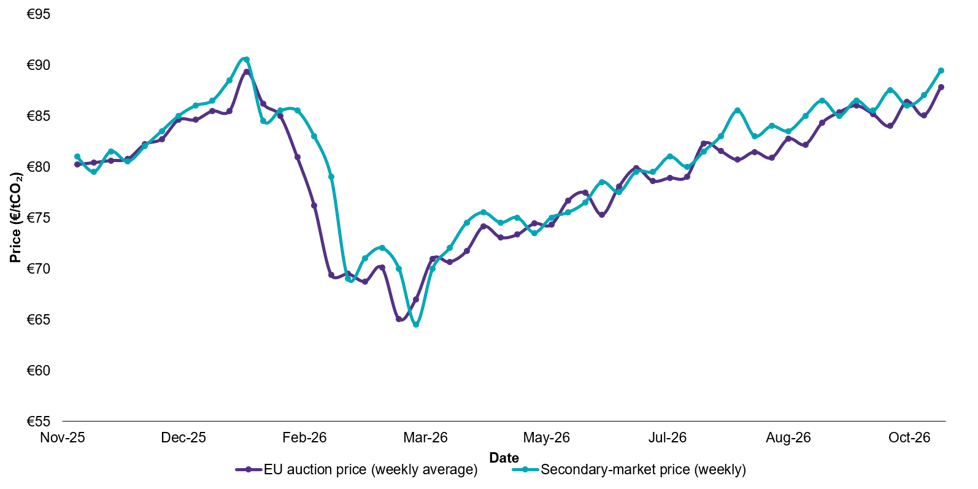
EUA auction price vs secondary-market price
2026 brings several changes together
In 2026, several developments come together: aviation has moved to full auctioning, maritime coverage reached 100% of in-scope emissions from January, with the corresponding surrender falling due in 2027, CBAM has entered its definitive regime, and ETS2 monitoring, reporting and verification are already under way ahead of full operation in 2028.
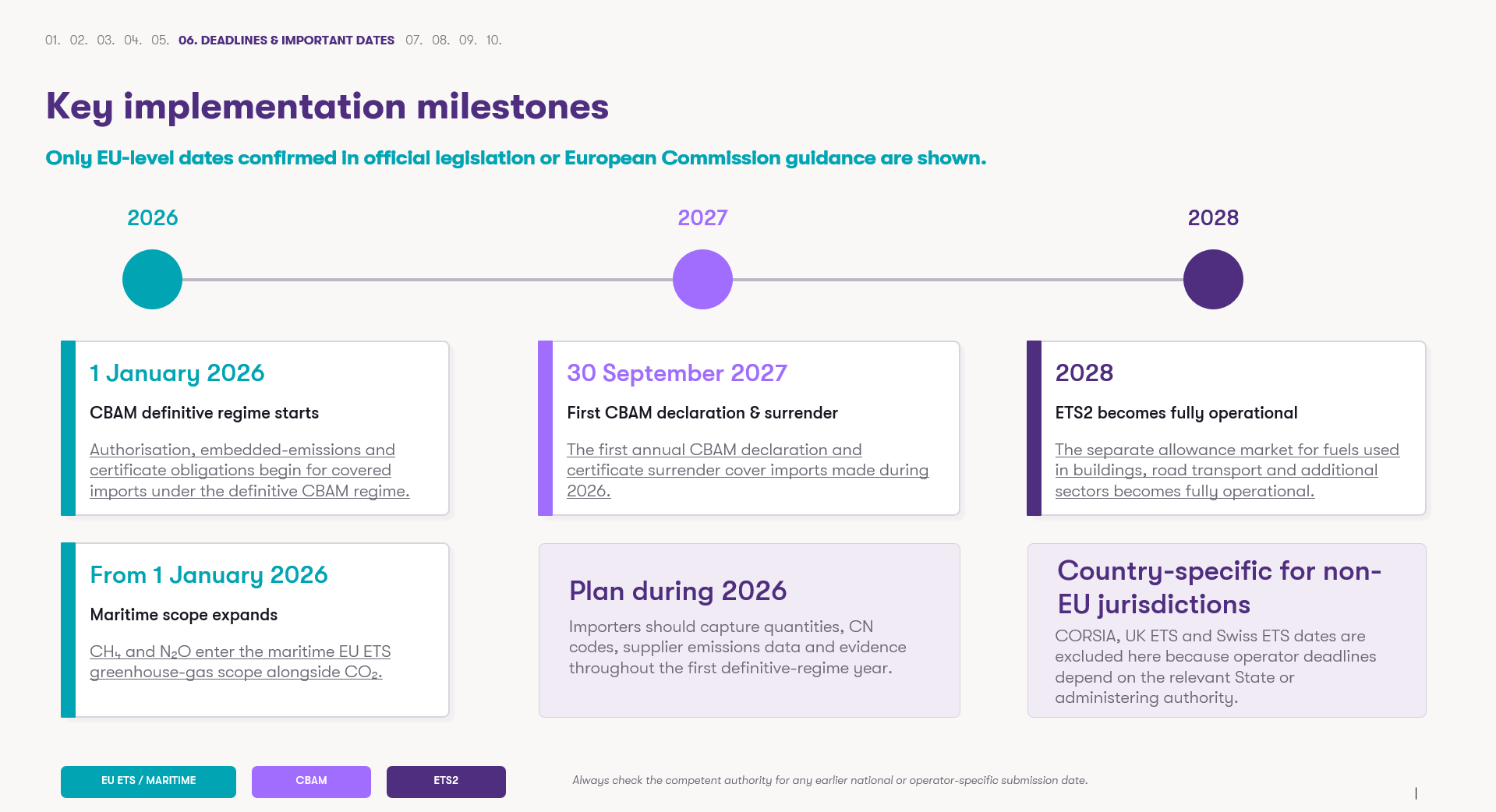
The direction is clear: carbon pricing is reaching a broader part of the economy. For businesses, that makes it worth understanding the exposure before it becomes a compliance deadline, an unexpected cost or a request for data that is difficult to answer.
So, where does your business stand?
Our EU Emissions Trading System reference guide was designed to help businesses answer that. Rather than a one-time read, it is a practical reference book you can return to when you need to understand:
- whether your business is in scope;
- which entity carries the obligation;
- what you need to do and by when;
- how the allowance market works;
- what compliance can cost;
- what the framework means specifically in Malta; and
- where EU carbon pricing is heading next.
Our sustainability team advises on EU ETS, UK ETS, Swiss ETS, CORSIA and CBAM obligations in Malta, from scoping and monitoring plans through to allowance procurement and surrender.
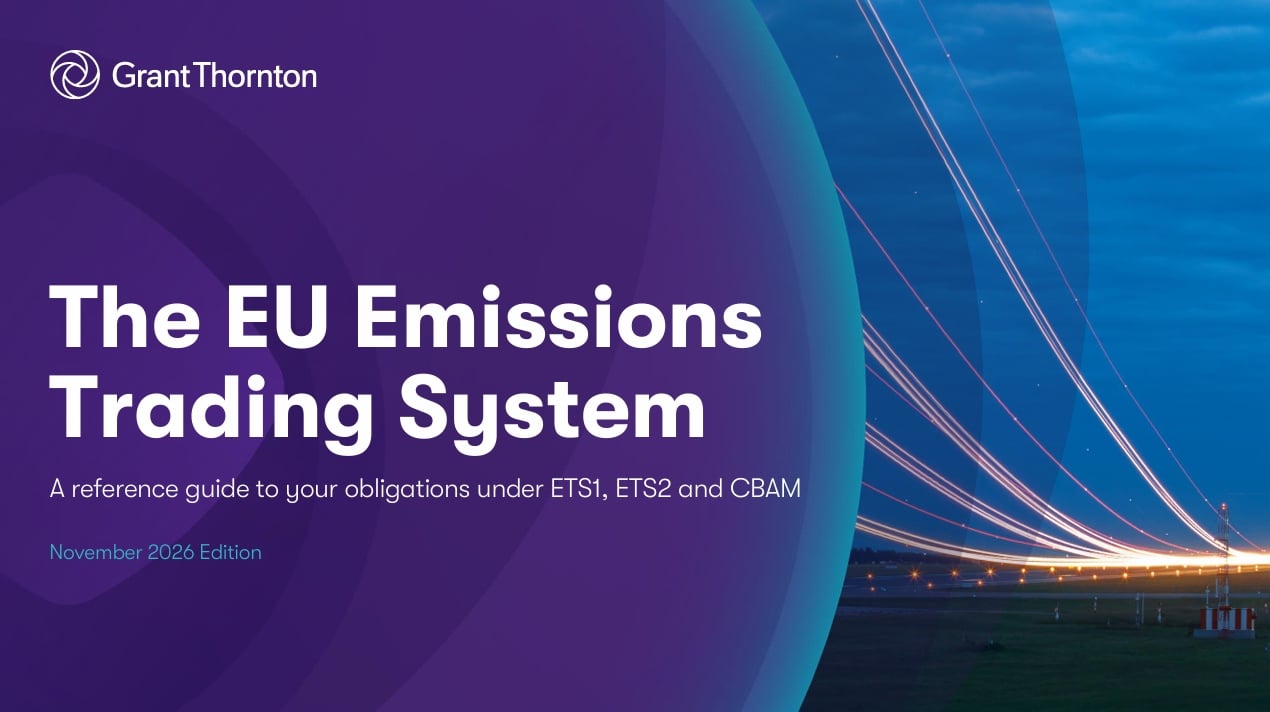
EU ETS Reference Guide
Download the full reference guide to understand your exposure and the practical steps that may apply to your business.
Authors
Read more about CBAM


George Vella
Managing Partner | Head of Advisory

Oriana Abela
Partner | Head of Capital Markets

Francesca Vella
Director | Head of Sustainability