Circular economy is not recycling with better branding. For Malta’s hotels and restaurants, it is about understanding where value is being lost, and how to keep more of that value inside the business.
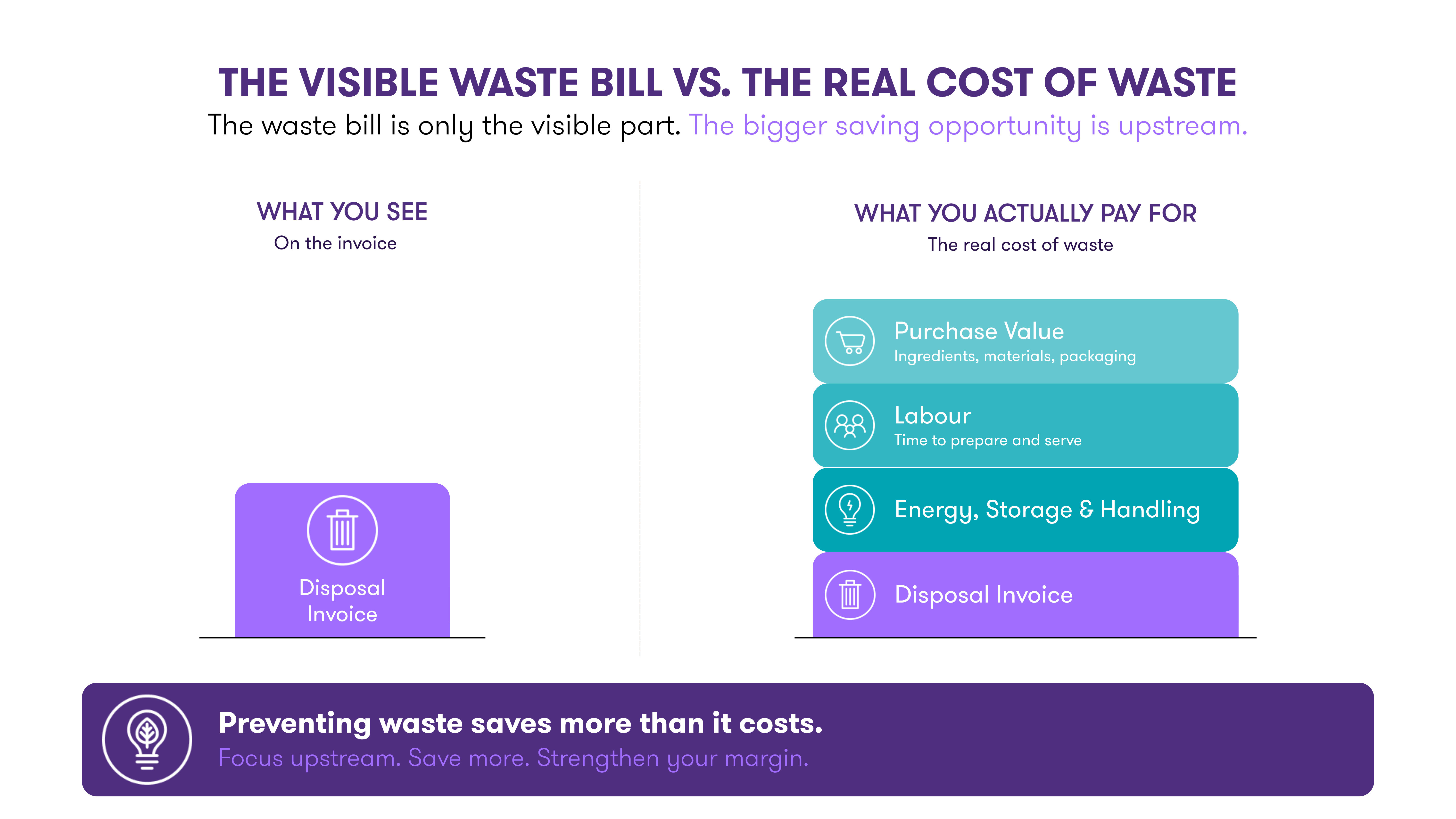
Every kilogram of food scraped off a plate has already been bought, delivered, stored, chilled, prepared, cooked and served before anyone pays to dispose of it. The waste invoice is only the most visible part of the cost. The larger cost has already moved through the accounts as food purchases, labour, energy, storage and handling.
Perhaps the most overlooked aspect of sustainability is that waste is not only an environmental issue, but a business issue. That message was reinforced at the recent Malta Hospitality and Restaurant Association (MHRA) Malta Hospitality Forum 2026, where the conversations that stayed with us were not about recycling rates, but about margin. When material, food or packaging leaves the system too early, it is a signal that money, time and resources have left with it.
Malta’s waste challenge is also an opportunity for hospitality
Malta’s waste figures show why this matters. In 2024, municipal waste generation reached 353,525 tonnes, up 6.1% on the previous year. That amounts to 621kg per resident, or 574kg when the net tourist daily population is included. The treatment picture is equally important. In 2024, 79.2% of treated municipal waste was landfilled, while source-separated collection improved to 36.3% of municipal waste generation. This shows progress, but also a clear limitation: Malta is getting better at separating some waste streams, while the overall volume of waste continues to rise.
For hospitality, this is particularly relevant. Hotels, restaurants and catering operations sit at the point where food, packaging, energy, water, logistics and guest experience all meet. Published hotel waste figures show how quickly this becomes operationally significant: one hotel group reported over 3.5 million kg of waste, around 2.7kg per guest, with roughly a third made up of food and organic waste that had already been bought, stored and prepared before being binned.
The financial impact is therefore not captured by the disposal invoice alone. WWF puts food waste at around 8% of a hotel’s total food costs, effectively €1 in the bin for every €12 spent in the kitchen. That makes the sector exposed to rising waste pressures, but it also gives it a strong opportunity to design waste out of the system before it becomes a disposal cost.
Government action is moving the sector in the right direction
Malta’s policy direction is already moving towards circularity with the Circular Economy Strategic Vision for 2020–2030. Measures such as mandatory waste separation, the Beverage Container Refund Scheme, extended producer responsibility, sustainable procurement actions and planned waste infrastructure investments are all part of this shift.
There are signs that these systems are changing behaviour. Reported commercial organic waste collected increased from 263,900kg in 2022 to around 6.5 million kg in 2025. In one sense, this is progress: more organic waste is being separated and captured instead of disappearing into mixed waste streams. But the figure should be read carefully. It tells us how much organic waste was collected, not how much was created. Better capture is important, but it does not automatically mean that less waste is being generated.
That is where the next opportunity lies. Malta is improving how waste is managed at the end of the process, but the bigger shift is to change what happens at the beginning: what is bought, prepared, portioned, stored and avoided before it ever reaches the bin.
Kiara Conings Senior Executive | Sustainability
The regulatory direction reinforces this. Malta’s mandatory waste separation rules already make correct disposal a baseline requirement for businesses. At EU level, the revised Waste Framework Directive introduces binding 2030 food waste reduction targets, including a 30% per capita reduction at retail and consumption level, covering restaurants, food services and households.
The EU Packaging and Packaging Waste Regulation will also apply from 12 August 2026, with requirements linked to packaging reduction, recyclability, reuse and refill phased in towards 2030.
Together, these measures point in the same direction: better disposal matters, but the next stage of circularity will be shaped by the decisions made before waste is created.
Revised EU Waste Framework Directive in force; binding 2030 food-waste targets set
12 Aug 2026
General PPWR application; restrictions relevant to food-contact packaging, including PFAS requirements
12 Feb 2027
HORECA must allow customers to bring their own container, subject to scope rules
12 Feb 2028
HORECA must offer a reusable takeaway option, subject to scope rules
1 Jan 2030
Further single-use restrictions and recyclability requirements; 2030 food-waste reduction target due
Note: Scope and de minimis rules may apply, so obligations should be assessed against the specific business model and legal requirements.
Regulations helps, but the biggest gains sit in the value chain
Regulation sets the direction, but it does not solve the full challenge on its own. Many operators are already separating waste, reducing single-use items, reviewing packaging and looking at food waste. The difficulty is that these efforts often happen in isolation.
A hotel can set a packaging target, but progress depends on whether suppliers offer better formats. A restaurant can separate organic waste, but the impact also depends on collection systems, treatment infrastructure and what happens after the bin is collected. Much of a property’s waste profile is influenced before products arrive and after they leave.
This fragmentation is exactly why circular economy should be approached as a value-chain opportunity. It is not a one-off project; it sits across procurement, operations, supplier relationships, data, reporting and destination-level collaboration.
3 practical opportunities for hotels and restaurants
Many waste issues start at the purchasing stage. Over-packaged deliveries, single-use items, non-repairable equipment and materials with no clear recovery route all become future costs. Circular procurement means looking at supplier terms, delivery formats, refillable and reusable options, durability, repairability and end-of-life routes before the purchase is made.
The aim is not simply to buy “greener” products. It is to avoid buying waste into the business in the first place.
In a busy hospitality setting, waste can easily become part of the routine. Food is ordered, prepared, served and cleared away, but without measuring what is being thrown away, it is difficult to know where the real issue starts. Once that information becomes visible, the discussion shifts from disposal to decision-making: what was bought, what was prepared, what was left unused, and where the same guest experience could be delivered with less waste.
This also applies beyond food. In housekeeping, maintenance and events, data can help challenge habits that create unnecessary consumption without improving the guest experience. The question becomes: what are we using, why are we using it, and where can the same outcome be achieved with less waste and lower cost?
No hotel or restaurant can become truly circular in isolation. That is where Malta has an advantage. Suppliers, waste handlers, farmers, local authorities, event organisers and hospitality operators are close enough to test partnerships, shared standards and reuse models at destination level.
Shared organic waste solutions, supplier take-back models, common event standards, reusable packaging networks and collaboration on local supply chains can move faster in a smaller market if the sector works together. This is not only environmental positioning; it is a way to reduce inefficiency across the system.
Data turns waste from a hidden cost into a management tool
The common thread across these opportunities is measurement. Without data, waste remains a general issue. With data, it becomes a management question: what did we buy, what did we use, what was discarded, what did it cost and what should change next?
At the MHRA conference, Effiwaste was a strong example of this shift. By measuring what hospitality kitchens throw away, by type and moment, the conversation moves from “how do we handle this waste?” to “how do we prevent this cost from arising?” That is a more useful question for chefs, procurement teams, finance teams and management.
A dashboard on its own is interesting. A dashboard linked to purchasing, supplier negotiations, operational planning, compliance deadlines and reporting becomes a business case.
Iberostar is proof at scale. Once measurement was built into their operations they diverted 81% of waste from landfill compared to the group’s 2021 baseline, and AI-assisted smart bins across more than 60 hotels also helped reduce food waste by 12% in the first year. The reductions followed the measurement, not the other way round.
Where Grant Thornton can help
Where Grant Thornton can help
This is where Grant Thornton can support hospitality businesses in moving from information to action. Effiwaste can help make the waste visible. Grant Thornton can help interpret what that data means for cost, risk, compliance and decision-making.
That may include mapping waste and carbon data against the P&L, identifying the waste streams with the highest financial impact, reviewing supplier and packaging exposure against upcoming requirements, building a practical reduction roadmap, and preparing proportionate reporting for lenders, partners and other stakeholders.
For businesses that need their numbers to stand up externally, this can also connect to wider ESG advisory, reporting and assurance support. The goal is not to create more reporting for its own sake. It is to give management the evidence needed to reduce cost, prepare for regulation and strengthen the resilience of the business.
Circular economy in hospitality is not about adding another sustainability slogan. It is about making the business more efficient, more prepared and more resilient.
Three questions can help operators understand where to start:
Which waste streams cost us the most once purchase value, labour, energy and handling are counted, not only disposal?
Which supplier contracts or packaging formats could create exposure under the 2027, 2028 and 2030 requirements?
What do we need to measure so decisions are based on evidence rather than assumptions?
For Malta’s hospitality and restaurant sector, the circular economy opportunity is therefore practical and commercial. Businesses that start measuring, collaborating and redesigning now will be better positioned to reduce costs, respond to regulation and contribute to a tourism model that protects the destination it depends on.